
14 Aug 2026 · Enric Massó · Cities & Places
A City Is More Interesting When You Have to Look at It
There is a very efficient way to visit a city without really seeing much of it. Follow the map, photograph the famous building, read the plaque, move to the next pin. At the end of the day you will have covered a respectable number of…
Cities become much more interesting when something forces you to look properly. A doorway you would normally pass suddenly matters because you are trying to work out what used to be there. A coat of arms stops being decoration when you need to identify one detail. Two buildings that seemed unrelated become part of the same story. You notice that a street bends strangely, that one façade does not quite belong to the square around it, or that a piece of stone has survived several different versions of the city.
None of this requires becoming an expert. In fact, expertise can sometimes get in the way. A historian may recognise a period immediately. A local may have stopped noticing the object years ago. A visitor who has been given a reason to pay attention can spend five minutes staring at something both of them would walk past.
A city is not a sequence of monuments
This is especially useful when travelling with teenagers, because the traditional cultural bargain is not always very attractive: an adult explains why something is important, the teenager agrees to stand near it, and everyone moves on. The city has already lost.
A mystery changes the relationship. Instead of receiving information, the reader needs something from the place. The building is no longer there to be admired; it contains evidence. History stops being a paragraph that somebody has decided you should know and becomes context that may help solve a problem. That small shift matters. Curiosity works better when it has a job.
It also changes what counts as a good location. The obvious landmark is not necessarily the best one. Sometimes a modest square, an altered façade or an architectural detail produces a stronger moment because the reader has to connect what is visible now with something that happened before. The pleasure comes from the gap between looking and noticing.
Barcelona is very good at this, partly because different versions of the city sit on top of one another. Roman, medieval, industrial and modern Barcelona are not arranged in separate exhibition halls. They collide. Buildings move, streets change function, old walls disappear into later structures, names survive after the thing they described has gone. You can walk through several centuries before lunch without needing anyone to announce that you have crossed a historical boundary.
For a writer, that is irresistible. For a reader, it creates a useful uncertainty: is this detail just a detail, or does it matter?
The best clue is one that was already there
When I started developing Barcelona Secret Agent, I wanted the missions to depend on the city rather than merely take place in it. There is a difference. A puzzle that could be moved from Barcelona to Prague by changing three street names is not really using Barcelona. The place is scenery.
A better challenge begins with something real that the reader can observe, interpret or connect. The fiction may create the reason for looking, but the city supplies the evidence. That makes the experience work even after the story is finished, because the reader has learned a slightly different way of walking.
I like that idea more than the usual promise that a book will “bring history to life”. History was already alive. The harder task is getting us to notice what it left behind.
Perhaps that is why urban mysteries work so well when they work at all. They exploit something cities already do naturally. A city hides its own past in plain sight, not because anyone designed a puzzle, but because people keep building on top of what came before.
The writer only has to give you a reason to stop. And once you start looking properly, ordinary streets become surprisingly bad at being ordinary.
Related book
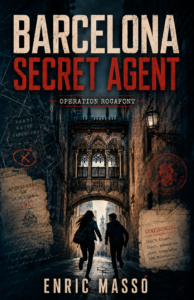
Barcelona Secret Agent: Operation Rocafont
A YA mystery that turns Barcelona into part of the investigation. Readers follow the story and solve observation-based missions using real places, historical traces and evidence hidden in the city around them.
Available on Amazon → [link pending]