
8 Jun 2025 · Enric Massó · Business & Management · Technology & AI
Your Business Does Not Need to Own Everything. It Does Need a Way Out.
Small companies used to own more of their technology because there was less technology to own. The accounting program lived on a computer in the office. Files were on a server, or on several computers in several states of organisation.…
Cloud software is cheaper to start with, easier to maintain and often dramatically more reliable than what a ten-person company could sensibly build for itself. Backups, updates, security, remote access and collaboration can all improve when somebody competent operates the infrastructure. The strange conclusion people sometimes draw from this is that because outsourcing is sensible, dependency no longer matters.
It matters precisely because outsourcing works so well. A business can gradually move invoicing, customer records, documents, bookings, communications, passwords, payroll and internal knowledge into systems it does not control. None of those decisions is necessarily bad. The risk appears when the company cannot answer a very simple question: if this tool stops working tomorrow, what exactly do we do?
“It is in the cloud” is not a recovery plan
Most technology failures are boring rather than cinematic. An account is locked. A payment fails. An integration changes. Somebody deletes the wrong thing. A supplier has an outage. A former employee was the only person who knew how something was configured. A service still exists but a feature the company depended on has disappeared.
The first useful distinction is between inconvenience and stoppage. If the tool used to design Christmas cards is unavailable for a day, nobody needs a continuity committee. If the company cannot issue invoices, access customer orders or recover the files required to deliver work, the same outage has a different meaning.
This sounds obvious until you ask a small company to list its critical tools. The list often begins with the visible ones and misses the dependencies underneath them: the email account used to reset every other password, the phone number receiving authentication codes, the domain name controlled by somebody who left three years ago, or the spreadsheet that quietly became the operational system.
Good continuity planning for a small business should be proportionate. It does not require a bunker, duplicate data centres or a seventy-page disaster recovery manual. It requires knowing what can stop the business, what can be recovered and who knows how.
The exit test
There is another question I find even more useful: can you leave? Not today, necessarily. Not because the supplier is bad. Simply as a test of whether the relationship is still a choice.
Can you export the data in a usable form? Would another system understand it? Do you know what configuration would need to be rebuilt? Are there alternative suppliers? How long would a switch realistically take? Is there a copy of the information you cannot afford to lose?
A backup helps only if it can become useful information again. An export helps only if somebody can understand what is inside it. An alternative supplier helps only if moving to it is possible before the business runs out of time.
This is why ownership is not the right objective. A small company does not become safer by bringing every server back into the office and making the owner an unwilling systems administrator. Often the external service is still the sensible option. What matters is avoiding a dependence that has quietly become irreversible.
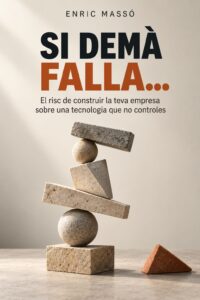
When I worked on Si demà falla, I kept coming back to that distinction. Technology is not a collection of products. From the point of view of a business, it is a collection of dependencies with different consequences.
Some deserve almost no attention. Some deserve a password written down in the right place. Some need a tested backup, an alternative procedure or a supplier who can explain how recovery works. A few may justify paying more because the cheap option leaves the company with nowhere to go.
The objective is not independence. Small businesses have better things to do than own everything. The objective is to know which doors are still doors before you need to use one.
Related book
Si demà falla El risc de construir la teva empresa sobre una tecnologia que no controles
A practical guide for small businesses to identify the technologies they truly depend on, understand what could stop operations and build realistic recovery and exit options without turning the owner into an IT specialist.
Available on Amazon → [link pending]